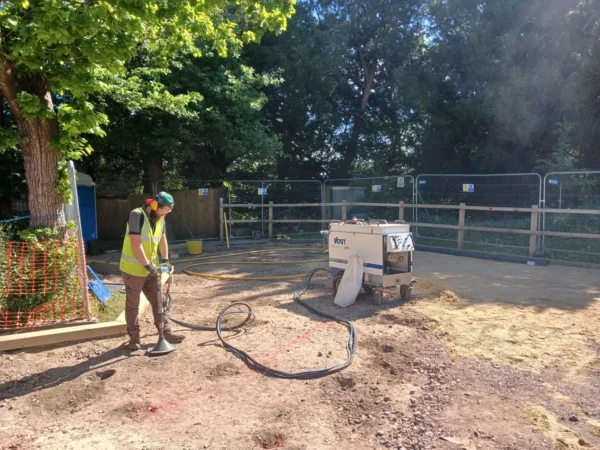
Site conditions
The works involved three TPO-protected trees — two individual specimens and one designated group — situated adjacent to a new car-parking area being constructed as part of a wider development programme.
Planning permission had been granted subject to a pre-commencement condition requiring an AMS. The AMS specified enriched biochar injection into the RPAs as a mitigation measure prior to surface installation.
Treatment carried out
Soil decompaction and aeration was carried out using the Vogt Geo-Injector Pro — a compressed-air probe system that fractures compacted soil and creates channels for gas exchange, water infiltration and root extension, without excavation or mechanical disturbance to root tissue. Injection points were placed at one-metre centres throughout the accessible root zone areas, in accordance with Geo-Tree standard protocol.
Carbon Gold GeoBlend was injected at each point, as specified in the AMS. GeoBlend is a biologically active substrate comprising biochar, zeolite, mycorrhizal fungi (Glomus spp.), Trichoderma spp., seaweed extract (Ascophyllum nodosum) and wormcasts. Once injected, the biochar provides a permanent porous habitat for soil biology to colonise, while the mycorrhizal and microbial inoculants work to expand root absorption capacity and build disease resistance within the root zone.
In addition to the specified treatment, Geo-Tree backfilled all injection holes with ITA Zeolite (Chabazite). Granular Zeolite maintains open aeration channels into the subsoil over the long term and improves the root zone’s capacity to retain water and nutrients. Zeolite is an inert, naturally occurring mineral with no phytotoxic properties.
Approximately 88 m² of accessible root zone was treated across the three trees.
Outcomes and honest expectations
The immediate effect of the treatment is the removal of a physical constraint on root function. Upon treatment, the root zone benefits from:
- Restored gas exchange and water infiltration through fractured compaction channels
- A permanent porous biochar habitat for soil biology to colonise and roots to exploit
- Mycorrhizal establishment expanding root absorption and nutrient uptake
- Microbial inoculation building disease resistance within the root zone
- Long-term nutrient and water retention via zeolite and biochar structure
- Direct biological nutrition from seaweed extract and wormcast components
These are below-ground processes. Canopy response is likely to manifest over one to two growing seasons as stabilisation of current condition rather than drastic visible improvement.
What the treatment provides is the best available conditions for natural recovery. Without intervention, continued decline under compacted conditions would have been the likely outcome.
Documentation and compliance
A full site treatment report was produced following the works, covering:
- Planning and arboricultural references
- Site conditions and access constraints
- Treatment method and materials applied
- Scope — area treated and injection point layout
- Site photography from the works day
- Outcomes, honest expectations, and follow-on recommendations
A full site treatment report was produced following the works and submitted to the principal contractor for planning compliance purposes and as a record for the ongoing management of the trees.
A note for arboricultural consultants and specifiers
If you are preparing an Arboricultural Method Statement that includes a recommendation for soil decompaction or biochar injection within an RPA, Geo-Tree is experienced in carrying out this work on live construction sites and producing the documentation required for planning compliance.
We are also available to discuss treatment specifications at the AMS stage — including realistic expectations of outcome, access constraints, and the suitability of enhancement materials such as zeolite for specific sites and species.
Work with Geo-Tree
Geo-Tree provides specialist soil decompaction and root zone treatment for protected trees, estate landscapes, and construction-adjacent arboricultural work across the UK.
Contact: [email protected] | 07369 243786 | geo-tree.co.uk
This case study has been anonymised. Site, client, and planning references have been withheld.