If you are comparing a French drain vs soil injection for a waterlogged garden, you have likely come across two main options: install a French drain, or have the soil decompacted and treated. Both address drainage problems — but they do so in fundamentally different ways, and for most compaction-driven waterlogging, they are not equally effective.
This is an honest comparison of both approaches: what each involves, what it costs in disruption and money, and which is more likely to give you lasting results.
What Is a French Drain?
A French drain is a trench — typically 30 to 60 centimetres wide and up to a metre deep — filled with gravel and containing a perforated pipe. Water that accumulates on the surface or in the upper soil layers finds its way into the trench, drains through the gravel, enters the pipe, and is redirected away from the problem area — to a soakaway, a watercourse, or a suitable outfall.
When the underlying problem is genuinely one of water having nowhere to go — where ground levels, topography, or proximity to a water table are directing water into your garden from elsewhere — a French drain can be an effective solution.
But where the problem is compacted soil that has lost its ability to absorb rainfall, a French drain treats the consequence rather than the cause.
What Causes Most Garden Waterlogging?
The majority of persistently waterlogged UK gardens — particularly in clay-heavy areas such as Oxfordshire, Berkshire, and Buckinghamshire — are suffering from compaction rather than an inherent drainage deficiency.
Healthy, uncompacted soil is full of pore space: tiny gaps between particles through which air, water, and plant roots move freely. When soil is compacted — by foot traffic, vehicle use, construction machinery, or simply years of heavy rainfall on bare ground — that pore space is reduced or eliminated. The soil becomes dense and relatively impermeable. Rainfall that would once have soaked in within hours now sits on the surface for days.
In many cases, a compacted pan develops: a hard, dense layer — sometimes as shallow as 20 to 30 centimetres below the surface — that acts as a physical barrier. Water penetrates the topsoil, hits the pan, and has nowhere to go.
A French drain can collect the overflow from this situation. But the compaction remains, the barrier remains, and the soil’s own drainage capacity remains unrestored. In gardens where compaction is the root cause, French drains frequently disappoint — they manage the symptom without fixing the problem.
What Is Soil Injection?
Soil injection is a different approach altogether. Rather than redirecting water away from the problem, it restores the soil’s own ability to absorb and drain it.
At GeoTree, we use the Vogt Geo-Injector Pro: a compressed-air system that drives a probe into the ground and delivers a burst of pressurised air and treatment materials directly into the subsoil. The compressed air fractures the compacted layers, opening fissures and aeration channels through the soil profile. The treatment materials injected into those channels do two things: they improve the physical structure of the soil, and they begin to restore the microbial and biological life that healthy soil depends on.
The materials we inject are chosen carefully. Carbon Gold GeoBlend — an enriched biochar — improves the soil’s structure, water-holding capacity, and its ability to support microbial and mycorrhizal colonisation. Alongside this, we inject ITA chabazite zeolite: a naturally occurring mineral that helps maintain the open channels created by the treatment, improving both drainage and the soil’s ability to hold nutrients at the root zone.
The result is a soil that can breathe again — one that has recovered some of its natural capacity to absorb rainfall, rather than one that simply has a pipe running through it to collect the overflow.
Comparing the Two Approaches
French Drain vs Soil Injection: The Core Difference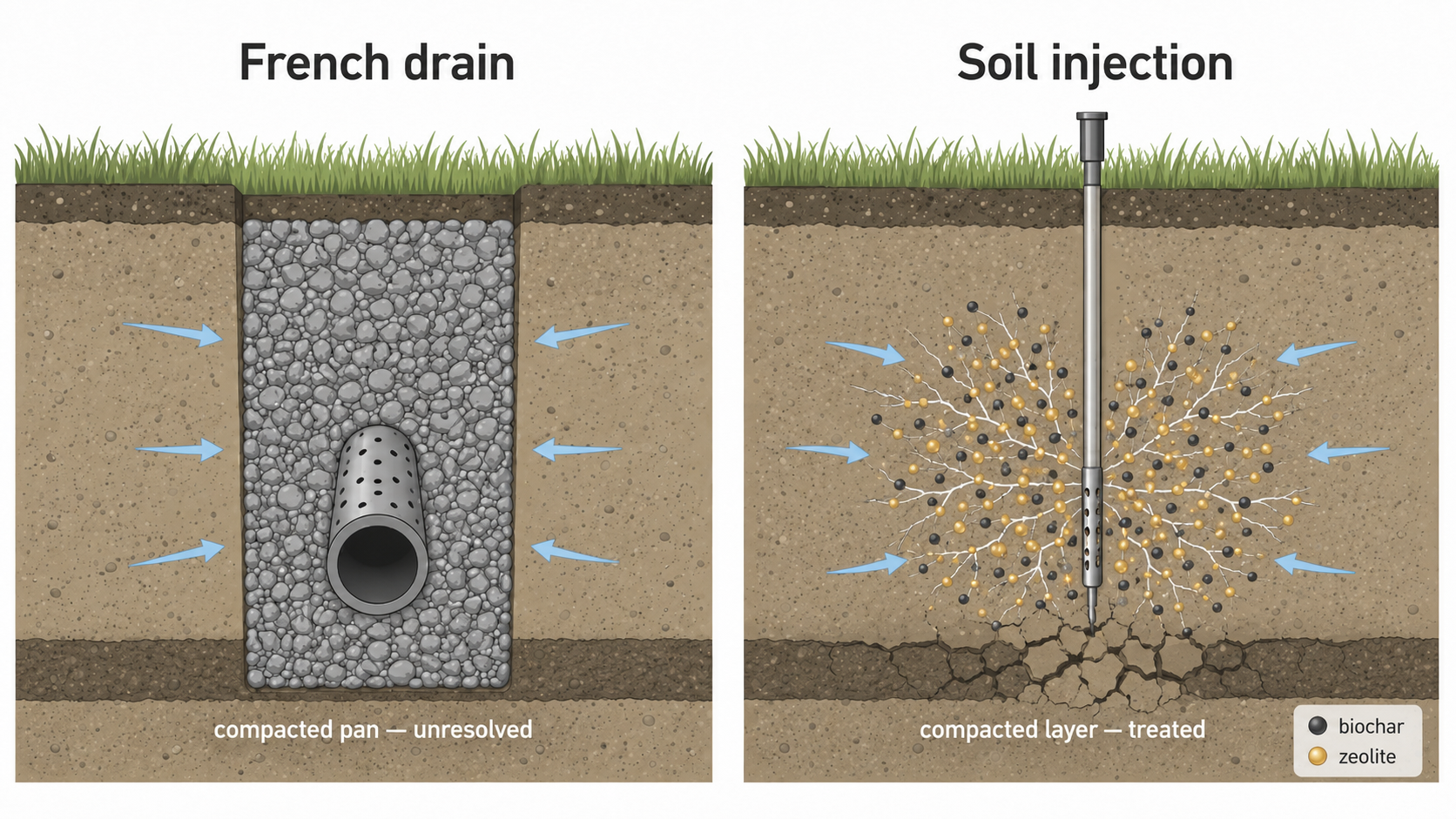
Disruption. A French drain requires excavation — typically a trench running the length of the problem area, with turf and topsoil removed, stored, and relaid. Depending on the size of the garden and the location of any existing features, this can be significant work. Soil injection requires no excavation. The probe leaves a small entry point — roughly the diameter of a finger — and the treatment is delivered entirely underground. Gardens are typically usable again within a day.
What it fixes. A French drain redirects water. Soil injection restores drainage capacity. If the underlying issue is compaction, only one of these addresses it directly.
Longevity. French drains require ongoing maintenance — gravel and pipe can silt up over time, particularly in clay soils, and may need flushing or replacement. A well-executed soil injection treatment, particularly one that includes zeolite to maintain the open channels, is designed to have lasting effect. The improvements to soil biology, structure, and drainage capacity do not rely on a pipe remaining clear.
Cost. A French drain installation varies significantly depending on length, depth, and ground conditions, but is typically a labour-intensive job involving plant or manual excavation. Soil injection is charged at a day rate. For comparable treatment areas, costs are broadly similar — but the work involved and the outcome are quite different.
When Is a French Drain the Right Choice?
A French drain is appropriate when water is entering a garden from outside — from a neighbouring property, a failing soakaway, rising groundwater, or topography that funnels water toward the area. If the soil itself drains adequately but is simply receiving more water than it can handle from an external source, redirecting that water via a French drain makes sense.
A soil investigation — or a conversation with someone who knows what to look for — will usually make clear which situation you are dealing with.
A Recent Example
A client in Berkshire came to us after having a French drain installed two years earlier. The lawn had improved initially, then returned to waterlogging the following winter. When we assessed the site, the drain was functioning — it was collecting water and directing it to a soakaway at the garden’s edge. But the soil itself was severely compacted to a depth of around 40 centimetres, and the water pooling on the lawn was coming from rainfall that the ground simply could not absorb. The French drain was collecting some of the overflow, but not addressing the underlying reason the water was accumulating.
We treated the area with the Vogt Geo-Injector, injecting Carbon Gold GeoBlend and ITA zeolite through the compacted profile. The following winter, the client reported the lawn no longer pooled after rainfall.
The Honest Summary
French drains are not the wrong solution — they are just the wrong solution for most garden waterlogging problems in the UK, where compaction is the primary cause. If you have already had drainage work done and the problem persists, that is usually the explanation.
If you are dealing with persistent waterlogging, or if you have tried surface aeration, drainage ditches, or French drains without lasting results, it is worth having the site properly assessed before committing to further work.
Get in touch to discuss your garden. We would be glad to help.