Understanding Clay Colloids
One of the key aspects of treating compacted soil is understanding what’s happening on the level of the clay colloid.
What Are Clay Colloids?
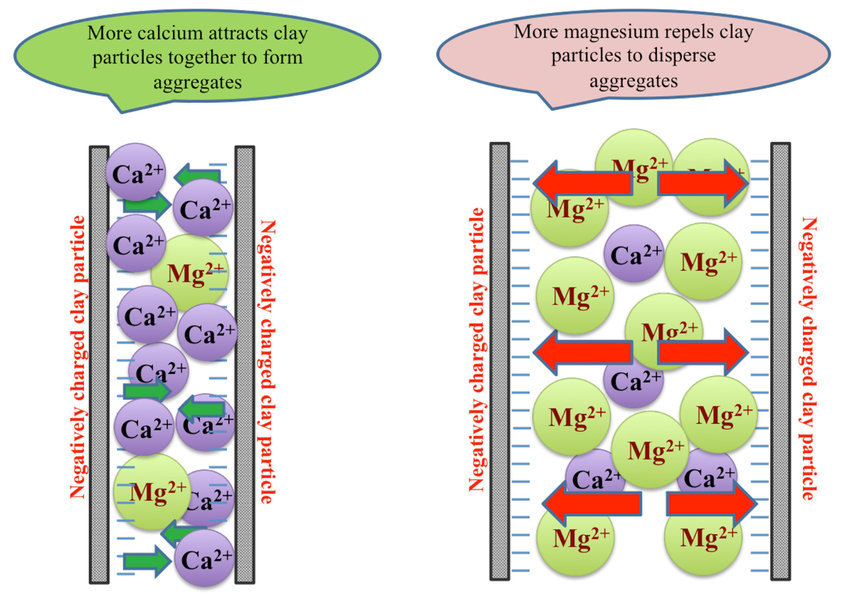
Clay colloids are the smallest mineral component of soil, typically less than 0.002 mm in size. Because they carry a negative electrical charge, they attract and hold positively charged ions, known as cations — including calcium (Ca²⁺) and magnesium (Mg²⁺).
This process of binding cations is central to the soil’s cation exchange capacity (CEC), which determines how well soil can retain and supply nutrients to plants.
Why Calcium and Magnesium Matter
The balance between calcium and magnesium on the clay colloid has a major influence on soil structure.
In simple terms:
Calcium ions are larger and have a lower charge density than magnesium ions. This means they tend to flocculate clay particles — encouraging them to cluster together into aggregates. This creates larger pore spaces, improving aeration, drainage, and root penetration. Think of the calcium ion as the bully-boy of the clay colloid, pushing off weaker ions and taking up more space.
Magnesium ions are smaller, with a higher charge density, which can cause clay particles to disperse when magnesium dominates. This leads to sealed, compacted, poorly draining soils — often seen as surface crusting when dry, and stickiness when wet. Dispersed clay can also migrate and block soil pores, further reducing water infiltration and air exchange.
Finding the Right Balance
An optimal calcium-to-magnesium ratio (Ca:Mg) is generally considered to be between 4:1 and 8:1 in many temperate clay soils. This range supports good aggregation while avoiding dispersion. However, the ideal ratio can vary depending on:
-
Soil type (e.g. clay vs sandy soils)
-
Organic matter levels
-
Existing soil structure
-
Sodium levels — excess sodium can also cause severe dispersion and may require calcium to correct
The Ca:Mg ratio is just one factor in a soil’s cation exchange capacity (CEC) — a measure of how well soil can hold onto and exchange nutrient cations like Ca²⁺, Mg²⁺, K⁺, and Na⁺. Clay-rich soils typically have higher CEC, making them more responsive to mineral balancing than sandy soils.
How We Improve Soil Structure
Alongside Geo-Tree’s compressed air decompaction treatments and the application of activated biochar, we now use a liquid gypsum product (calcium sulfate) as a fast-acting calcium source.
Liquid gypsum supplies soluble calcium without raising soil pH, making it ideal for acid soils or areas with magnesium or sodium imbalance. It rapidly displaces excess magnesium on the clay colloid and promotes flocculation. This helps restore stable soil aggregates, improving soil porosity and enabling oxygen, water, and roots to penetrate more freely.
Changes in structure may begin within weeks of application, particularly when combined with physical aeration and biological stimulation.
A Holistic Approach to Soil Care
This is a truly holistic approach to soil health — delivering visible results for our clients while building lasting resilience and nourishment for all the living elements in your soil.
Interested in improving the quality of your soil?
Get in touch — we’d love to help.